Jev, What Is a System One Model
I use a support ticket to examine Jev, the System One name, and the limits of typed decisions, probabilities, and published evaluations.

When I first read about TypeSafe AI’s Jev, I wanted to know where I would put it in an ordinary program. A support workflow often needs small judgments: which queue should receive a ticket, whether the customer is asking for a refund, and how frustrated they sound. A generative model can answer those questions, sometimes with a constrained output format. Jev makes the narrow decision its main interface.
TypeSafe calls Jev its first public “System One model.” It takes text or JSON state and a set of questions defined in advance, then returns answers and probabilities that code can use directly. That is the interface described in TypeSafe’s launch post and documentation. I have read the public material, and also called the Jev API myself.
Why call it System One?
TypeSafe borrowed the name from the distinction Daniel Kahneman popularized in Thinking, Fast and Slow. System 1 is fast and intuitive; System 2 is slower and more deliberate. TypeSafe uses the first label for focused judgments that can be made quickly. “Does this message ask for a refund?” fits. “Investigate the case and decide the best response” bundles several judgments with policy choices. Jev returns constrained decisions rather than writing a reply, code, or an explanation of its reasoning. TypeSafe explains the name in its launch post and the question shape in its docs.
The name describes the work TypeSafe wants Jev to do. It tells me nothing about whether the model works like a person’s fast thinking, or about its internal architecture. TypeSafe mentions a new architecture, parallel sampling, and a training method without publishing enough detail to reconstruct them. I can examine the API contract and how code uses its answers.
One ticket, three judgments
Suppose a customer writes, “I can’t log in, and I’ve been charged twice. Please refund me.” An application could put the message and relevant account records into one state, then ask Jev three questions:
| Question type | What it asks about the ticket | What comes back |
|---|---|---|
Choice |
Should this go to billing, technical support, or another queue? | One of the defined options, probabilities for each option, and confidence |
Score |
How frustrated does the customer sound? | A position on a defined scale, probabilities for each level, and confidence |
Noul |
Does the message request a refund? | A yes probability from 0 to 1, with no separate confidence field |
These are TypeSafe’s three question primitives. A Score can fall between levels on the scale. A Noul value of 0.5 means the model gives yes and no equal probability, rather than a middle rating. All three questions see the same state and are evaluated independently in one parallel request. Code combines the results; one answer does not silently feed into another question.
Jev supplies the semantic judgments in this example. The application checks transaction records, the refund policy, and permissions before it routes the ticket. If the records are incomplete or the judgment is uncertain, it can send the case for human review. A model’s judgment that the customer requested a refund does not authorize a refund. TypeSafe describes this split between model judgments and deterministic checks in its workflow guide.
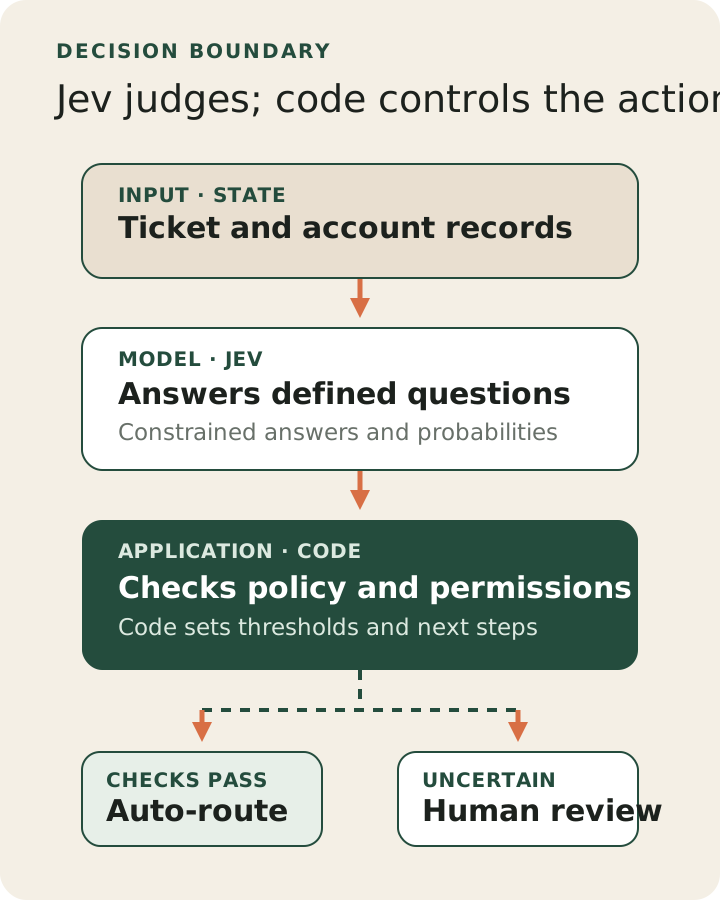 This is an illustrative workflow based on the documented interface, not a captured Jev run.
What types and probabilities could tell
A Choice answer stays within the options the developer supplied. If the ticket could fall outside those options, the question needs an “other” or “none of the above” choice. Otherwise, the model may choose a poor fit from the available list. TypeSafe makes the same recommendation in its question design guide. Constrained output saves the application from interpreting free-form text; it cannot make an incorrect classification true.
The numbers need just as much care. Noul reports the model’s probability that a statement is true. For Choice and Score, confidence summarizes how concentrated the distribution is. Concentration tells me which answer the model favors, not how often that one answer will be correct. Calibration has to be measured across cases: among predictions near 0.8, roughly 80% should be correct. TypeSafe’s confidence guide advises setting thresholds according to the task and the risk of the action.
I would test error rates and calibration on labeled tickets before deciding which cases to route automatically. Payments and deletions would also need their own policy checks. Jev’s type constraint governs the shape of an answer; it cannot repair missing state, a vague question, or a mistaken policy.
What the published evidence saying
TypeSafe’s workflow evaluations put several models through the same code-defined workflows, each composed of narrow questions. The comparison tells us how Jev performs within those workflows and against their reference answers. TypeSafe designed the workflows, and the reference answers come from the average judgments of GPT-6 Astra and Claude Fable 5.1. Its launch post acknowledges those limitations and says the largest speed and cost gains on its homepage are at the high end of its results. I would not generalize them to every classification task.
The launch post also plots “zero hallucinations” for Jev, then explains that its zero comes from a schema guarantee rather than an empirical test of factual accuracy. Jev cannot invent an answer outside the declared options, but it can choose the wrong option. To test how well it generalizes, I would pin a model version and vary the ticket domain, answer categories, and language, then measure accuracy, calibration, and failures in the full workflow. TypeSafe says English is Jev’s primary training language and advises testing other languages, including CJK scripts, on local data. Its model documentation describes that language boundary.
Before turning on automatic routing, I think the best to do is use labeled tickets from that workflow to measure errors and choose a review threshold. The public interface shows me where Jev fits. Those tests would tell me whether its judgments are good enough for my cases, while I actually tested on work in fact ahah.